About Trisha Brown
One of the most influential choreographers of her time, Trisha Brown (1936–2017), forever transformed the landscape of contemporary dance. A student of Anna Halprin, Brown participated in Robert Dunn’s choreographic workshops, leading to the formation of Judson Dance Theater and the explosion of interdisciplinary creativity that defined 1960s New York.
In 1970, Brown founded Trisha Brown Dance Company (TBDC), embarking on four decades of artistic exploration. She created over 100 choreographies, six operas, and a body of visual art recognized in museum exhibitions worldwide. Her earliest works were shaped by the urban environment of downtown SoHo, where she experimented with site-specific performances. By the 1970s, as Brown developed a singular abstract movement language, her work found a home in art galleries, museums, and international exhibitions. A pivotal shift came in 1979 when she moved from unconventional spaces to the proscenium stage, integrating her experimental vocabulary into traditional theatrical settings.
Brown’s contributions earned her nearly every major award for contemporary choreographers. She was the first woman to receive the MacArthur “Genius Grant” (1991) and was honored with five National Endowment for the Arts fellowships, two Guggenheim Fellowships, and Brandeis University’s Creative Arts Medal in Dance (1982). France named her Chevalier dans l’Ordre des Arts et Lettres (1988), and she received the New York State Governor’s Arts Award (1999), the National Medal of Arts (2003), and the New York Dance and Performance Bessie Lifetime Achievement Award (2011). That same year, she was awarded the Dorothy and Lillian Gish Prize for her “outstanding contribution to the beauty of the world.”
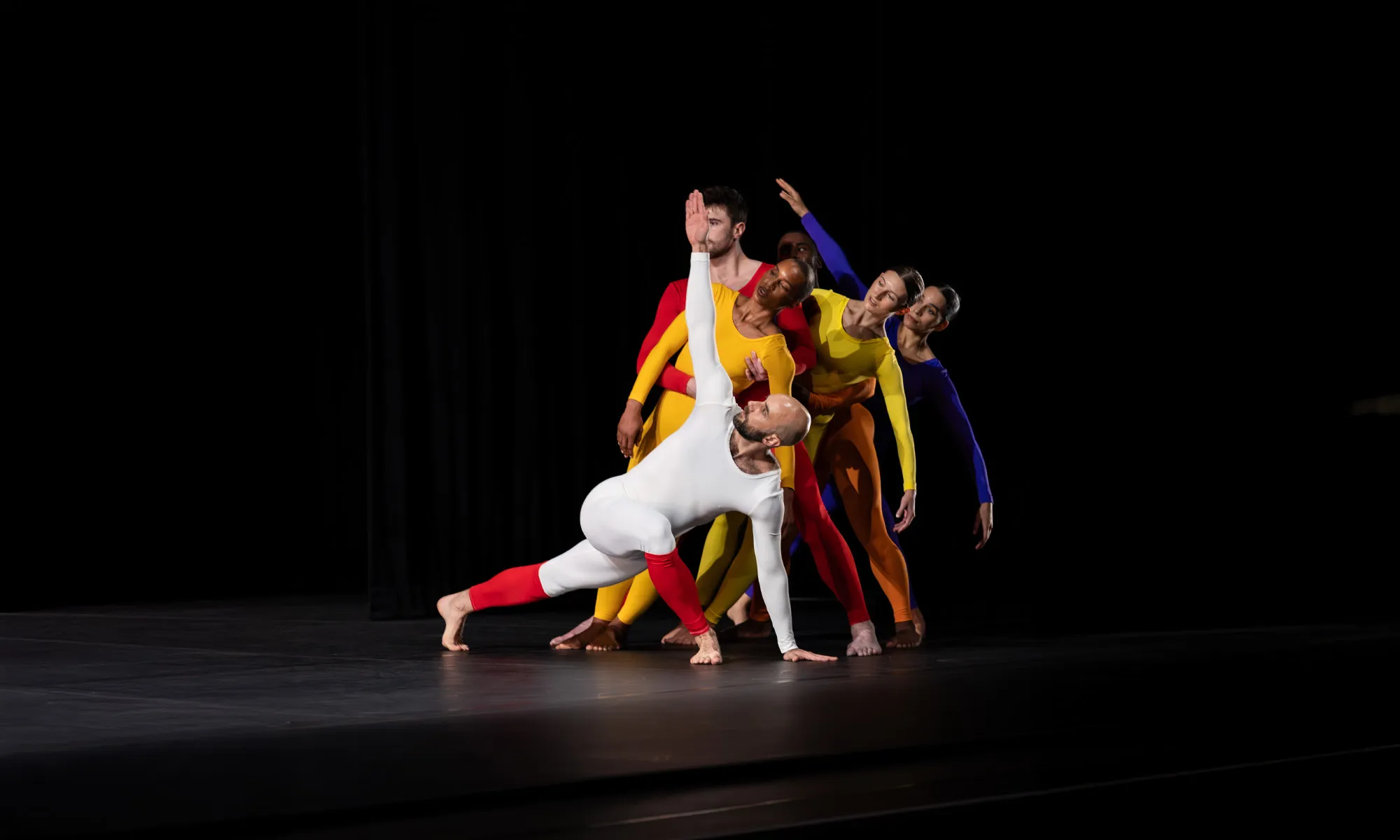
Today, Trisha Brown Dance Company continues to honor her legacy through performances, education, licensing, and archival initiatives. The company reconstructs and remounts Brown’s major proscenium works from 1979–2011, alongside its In Plain Site initiative, which reinvigorates her choreography by adapting it to new spaces. In 2023, TBDC expanded its mission to include commissions from a new generation of artists, engaging contemporary voices whose work resonates with Brown’s legacy while reaffirming its primary role in preserving her groundbreaking contributions to dance.
About Merce Cunningham
Merce Cunningham (1919–2009) was a celebrated dancer and choreographer renowned for his groundbreaking work, his lifelong passion for innovation, and his profound influence on generations of dancemakers and artists.
Born in Centralia, Washington, he attended the Cornish School in Seattle, where he was introduced to the work of Martha Graham and met the composer John Cage, who would become his closest collaborator and life partner. In 1939, Cunningham began a six-year tenure as a soloist in the Graham company, and soon began presenting his own choreography, most notably on joint music and dance concerts with Cage. In the summer of 1953, during a teaching residency at Black Mountain College, Cunningham formed a dance company to explore his innovative ideas. Over the course of his seventy-year career, he choreographed 180 dances, including such iconic works as Summerspace, RainForest, Sounddance, Travelogue, Pictures, Beach Birds, BIPED, and Ocean. He also presented nearly 800 events in museums, gymnasiums, outdoor stages, and theaters, beginning in 1964 with the Museum Event No. 1 at the Museum des 20.Jahrhunderts. Cunningham premiered his final work, Nearly Ninety, on his ninetieth birthday. The Merce Cunningham Dance Company remained in continuous operation until its closure in 2011, giving nearly 3,000 performances in over forty countries.
In collaboration with John Cage, Cunningham proposed a series of radical ideas, including the separation of music and dance, the use of chance operations, and novel ways to utilize film and technology. He collaborated with such renowned artists and composers as Robert Rauschenberg, Jasper Johns, Andy Warhol, Frank Stella, David Tudor, Christian Wolff, and Takehisa Kosugi. Cunningham earned some of the highest honors bestowed in the arts, including a MacArthur Fellowship (1985), a Kennedy Center Honor (1985), a Laurence Olivier Award (1985), the National Medal of Arts (1990), and Japan’s Praemium Imperiale (2005). In 2004, he was named Officier of the Legion d’Honneur. Today, Cunningham’s work continues to be performed by professional and student dancers worldwide, and Cunningham Technique® is taught in countless studios and educational institutions.
About Robert Rauschenberg
Born in Port Arthur, Texas, Robert Rauschenberg (1925–2008) attended Black Mountain College in North Carolina and the Art Students League in New York, where he developed creative relationships and methods that proved to be formative. His nearly sixty-year career was characterized by an irreverent and innovative approach to images, mediums, and disciplines, and a love for artistic partnerships.
Rauschenberg realized his first Combine (a term he invented to describe a series of works that hybridized aspects of painting and sculpture using materials of everyday life) in 1954, eschewing established artistic boundaries and hierarchies. Collaborations with composer John Cage and dancer/choreographer Merce Cunningham spurred Rauschenberg to add performance to his wide-ranging palette, including costume and set designs for the Cunningham and Paul Taylor dance companies. Rauschenberg’s Combine Minutiae (1954) occupied the stage, serving as the set for the company’s namesake Cunningham choreography, initiating more than two dozen collaborations over five decades, and culminating in a set and costumes for Cunningham’s XOVER (2007).
Rauschenberg’s affiliation with the Judson Dance Theater motivated him to choreograph his first performance, Pelican (1963), and it led to a lifelong friendship with dancer/choreographer Trisha Brown, highlighted by numerous artistic collaborations. Brown performed in a number of Rauschenberg’s experimental works, including Spring Training (1965), Map Room II (1965), and Linoleum (1966). An avid admirer of Brown’s choreography, Rauschenberg in turn designed costumes, sets, lighting, and, on occasion, music for her performances. These collaborations were mutually inspiring.
Rauschenberg’s set design for Brown’s Glacial Decoy (1979) led him back to photography, which became a driving force for his own work over the next decade and a half. Using his own photographs to silkscreen the costumes for Brown’s Set and Reset (1983) reintroduced a vital technique that Rauschenberg would employ in numerous series over the next dozen years. During the Rauschenberg Overseas Culture Interchange (ROCI, 1984–91), he arranged for Brown to preview Astral Convertible (1989), precursor to Astral Converted (1991), for which he designed the set and costumes, at the Cultural Palace in Moscow at the time of the opening of ROCI USSR. In 1990, he again designed the set and costumes for Foray Forêt, which premiered at the Biennale de la Danse in Lyon.